Personality
The Personality module reveals who you are through eight measured psychological traits. After completing the Personality assessment, you receive a full analysis: an interactive radar chart, a personality overview with strength tiers, quick stat rankings, and individual trait cards with detailed interpretations and concrete action steps. This page explains every section so you can use your results to guide your studies, career choices, and personal growth.
Warning — Take the assessment in a calm, focused environment. Your personality results are only as accurate as the honesty and mindfulness you bring to the questions. Find a quiet place, set aside at least 15–20 uninterrupted minutes, put your phone away, and answer each question based on how you actually behave — not how you wish you behaved. Rushed or distracted answers will skew your trait scores and reduce the quality of your university and career recommendations.
1. Prerequisite: Complete the Personality Assessment
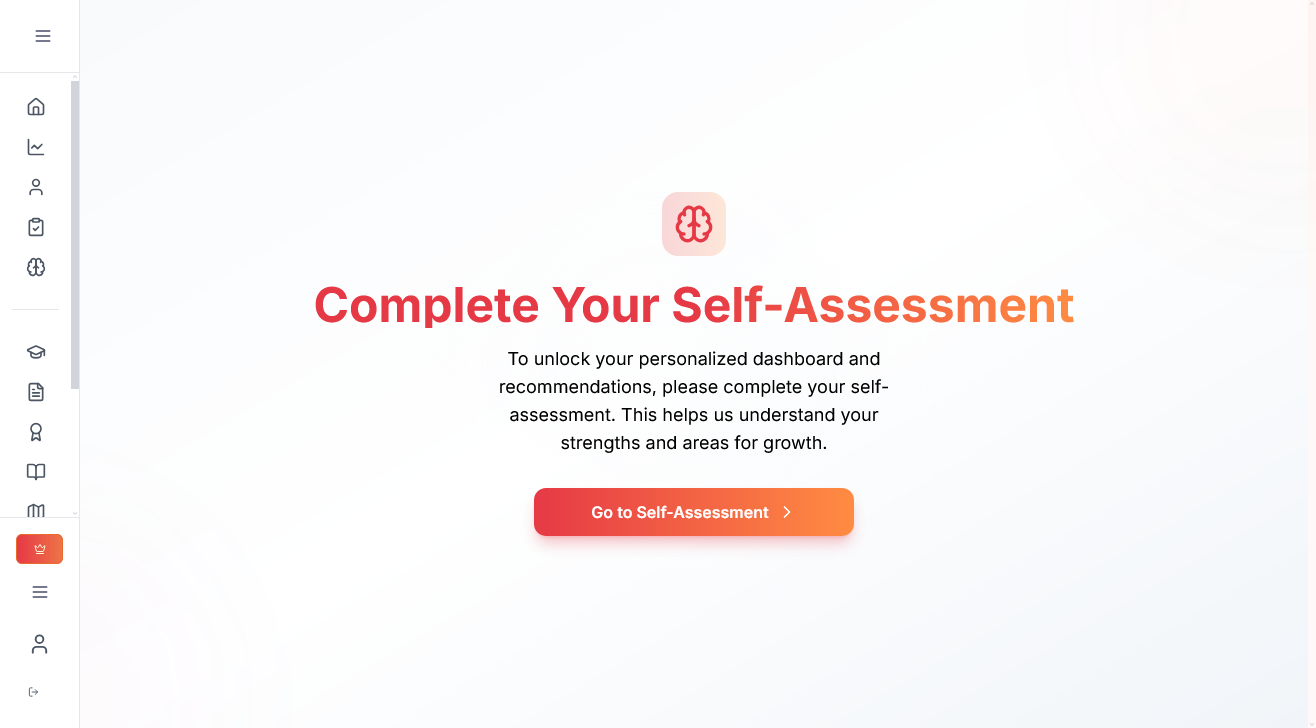
The Personality page is locked until you finish the assessment. If you see a locked state:
- From the sidebar, click Assessment.
- Locate the Personality assessment card.
- Click Start and work through every question without skipping.
- Submit the assessment when all questions are complete.
- Return to the sidebar and click Personality — your full analysis is now unlocked.
Note: Once you submit, results are generated instantly. You do not need to wait or refresh.
2. The Personality Insights Header
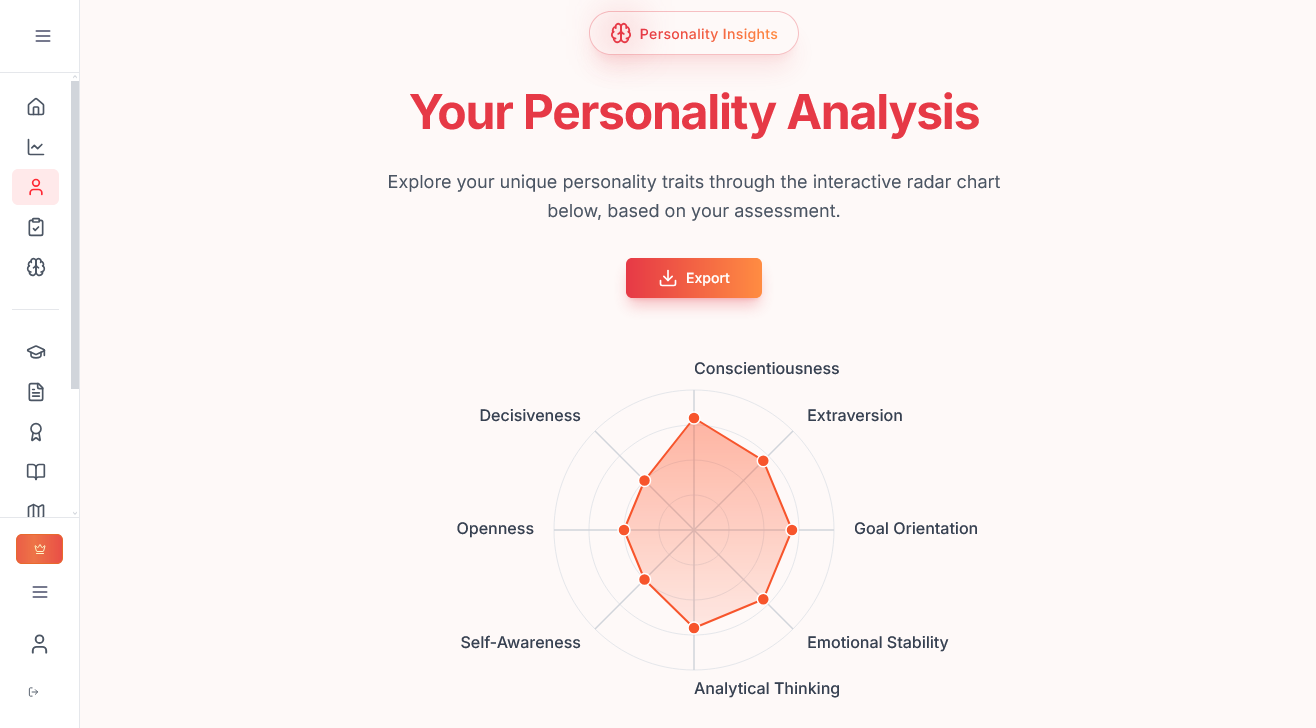
At the top of the page you will see a Personality Insights badge and the heading Your Personality Analysis, followed by the subline:
“Explore your unique personality traits through the interactive radar chart below, based on your assessment.”
Below the heading is the Export button — this lets you download your full report at any time. See section 7 for full export steps.
3. Reading the Radar Chart
The radar chart is the first visual you see after the header. It plots all eight traits simultaneously so you can grasp your overall profile shape at a glance.
The Eight Traits on the Chart
| Trait | Axis position on chart | What it measures |
|---|---|---|
| Emotional Balance | Top centre | How steadily you manage your feelings under pressure |
| Social Connection | Right | Your ability to build and sustain positive relationships |
| Mental Agility | Lower right | Cognitive flexibility and capacity for clear thinking |
| Inner Drive | Lower right-centre | Internal motivation and self-push to reach goals |
| Self-Awareness | Bottom centre | Understanding of your own traits, behaviours, and impact |
| Growth Mindset | Lower left | Openness to learning, challenges, and self-improvement |
| Adaptive Thinking | Left | Thoughtfulness and balanced decision-making |
| Goal Focus | Upper left | Clarity of vision and directed energy toward goals |
How to Read the Chart
- Look at the overall shape — a large, even polygon means broadly developed traits. A lopsided shape signals strong peaks and clear growth areas.
- Identify the outermost points — these are your Top Strengths (scores 7–10).
- Identify the innermost points — these are your Growth Areas (scores 1–5), which represent the biggest opportunities for self-improvement.
- Hover over any axis point to see the exact numeric score for that trait.
4. The Personality Overview Panel
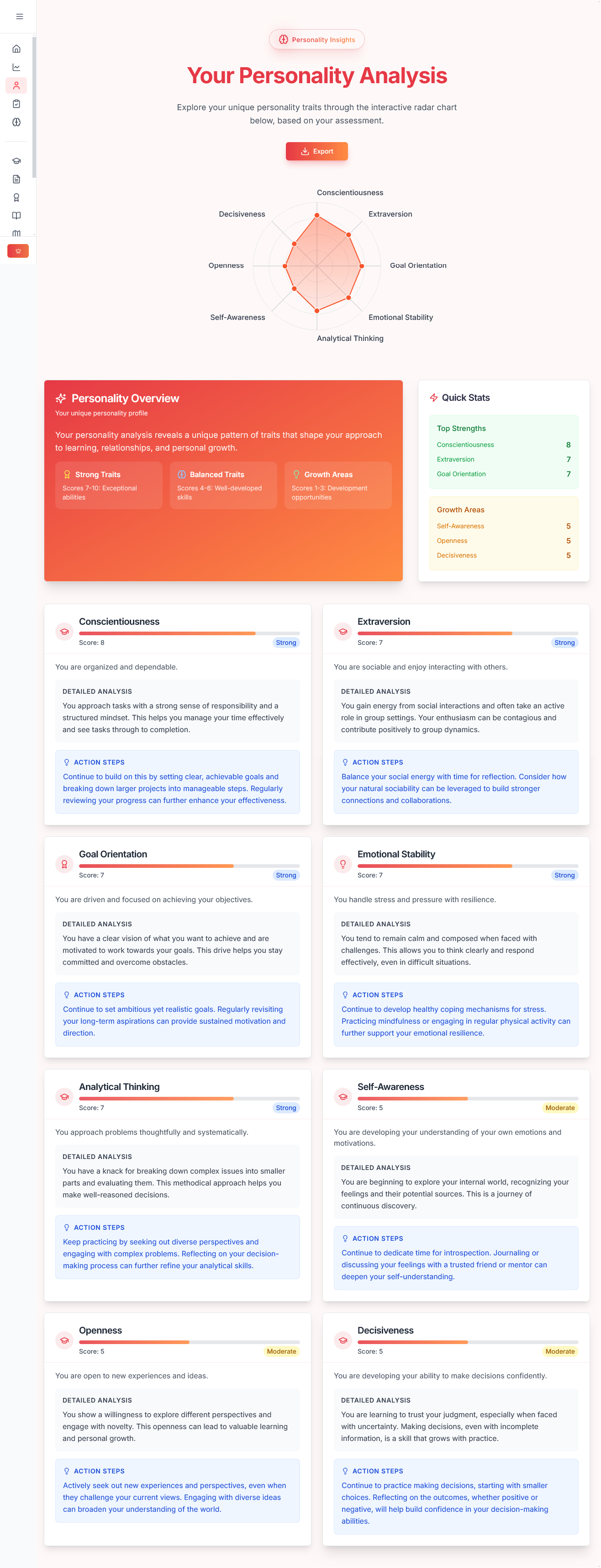
Directly below the radar chart, the Personality Overview panel gives a written summary of your profile organised into three tiers.
| Tier | Score range | What it means |
|---|---|---|
| Strong Traits | Scores 7–10: Exceptional abilities | These are your natural strengths — behaviours that come easily and can be leveraged for academic and career success |
| Balanced Traits | Scores 4–6: Well-developed skills | Solid, reliable skills that with moderate attention can become strengths |
| Growth Areas | Scores 1–3: Development opportunities | Traits that are currently underdeveloped and represent your highest-potential areas of improvement |
The overview card opens with a paragraph describing the unique pattern of your results and how your traits shape your approach to learning, relationships, and personal growth.
5. Quick Stats Panel
To the right of the Personality Overview is the Quick Stats panel. It lists your highest-scoring traits under Top Strengths and your lowest-scoring traits under Growth Areas, each with their numeric score shown.
How to use Quick Stats:
- Use the Top Strengths list to identify which traits to emphasise in application essays, interviews, and conversations with your advisor.
- Use the Growth Areas list to prioritise which Action Steps (from the trait cards below) to work on first.
6. Individual Trait Cards
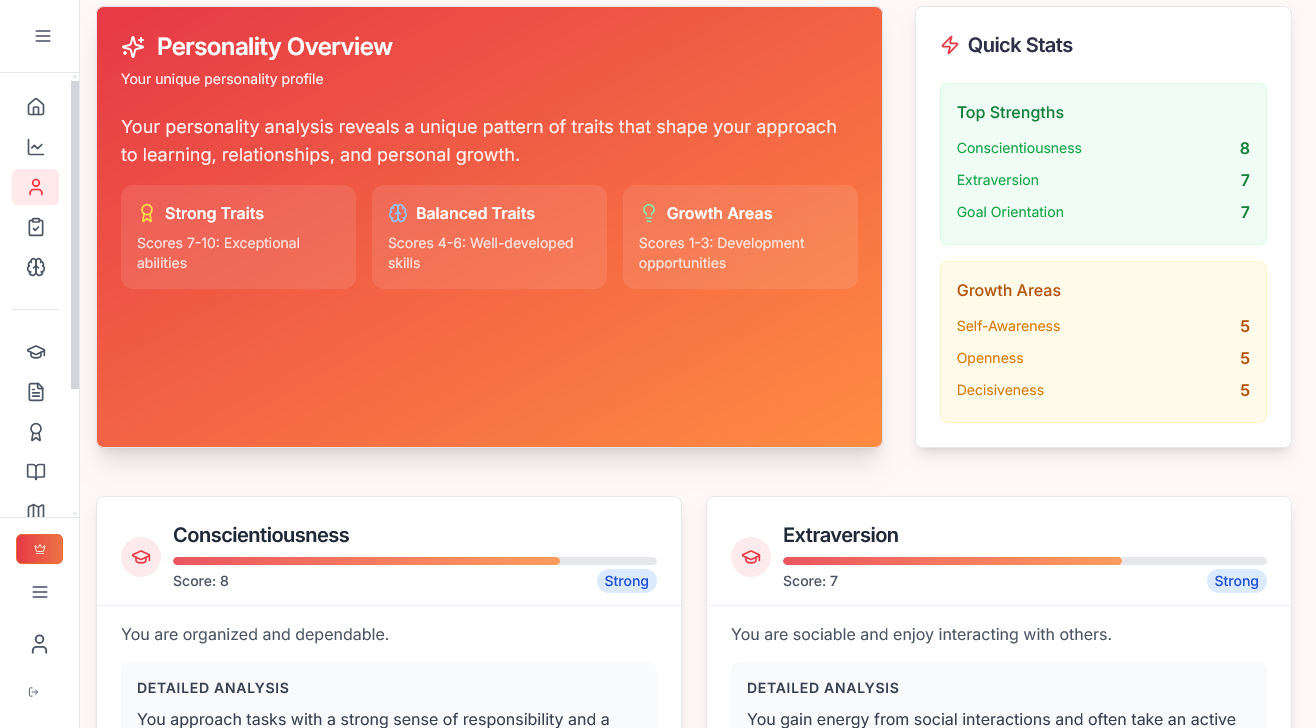
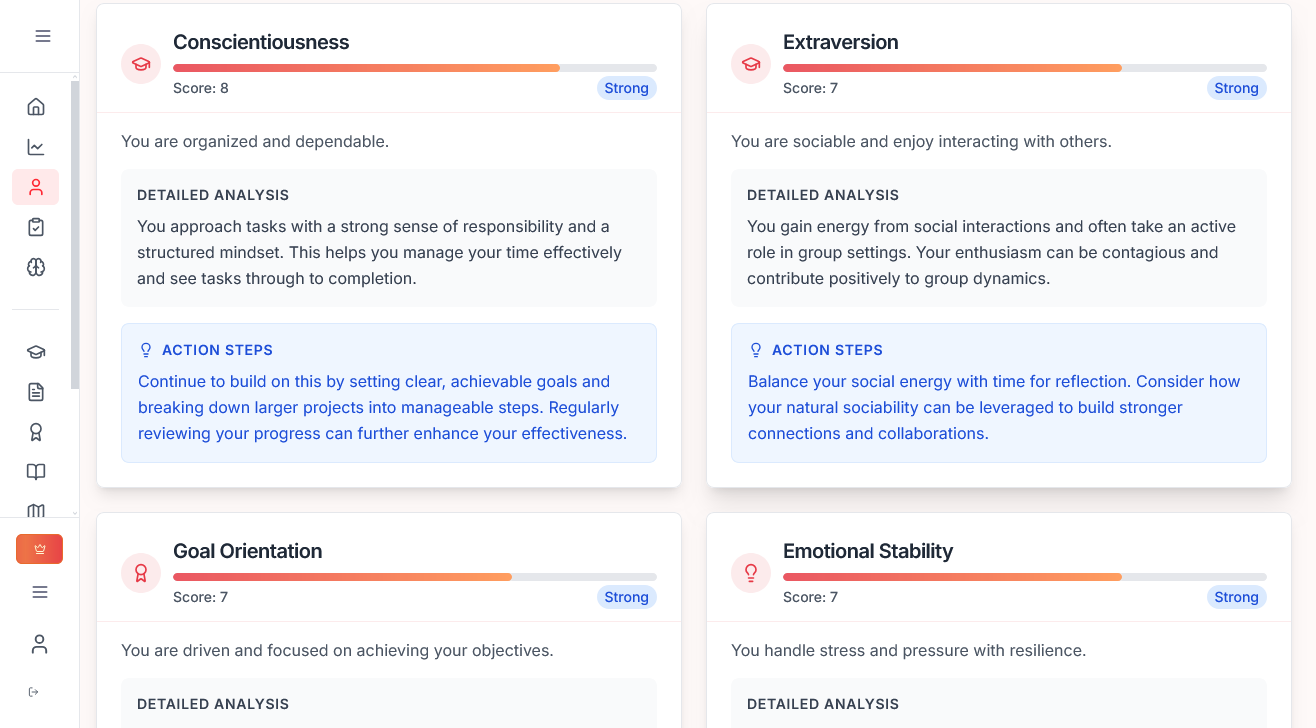
Below the overview section, every one of the eight traits has its own card. Each card follows the same structure and tells you exactly what your score means and what to do about it.
Card Anatomy
| Element | What it shows |
|---|---|
| Trait name | The name of the measured trait |
| Score bar | A filled progress bar representing 1–10 scale |
| Score number | Your exact numeric score |
| Level label | Colour-coded label: Exceptional (green), Strong (green), Moderate (orange) |
| One-liner | A single sentence summary of what the score says about you |
| Detailed Analysis | A paragraph-length explanation of how this trait manifests in your daily life, study habits, and decision-making |
| Action Steps | One or two concrete, practical things you can do right now to build on a strength or develop a growth area |
The Eight Trait Cards in Detail
Growth Mindset
Your openness to learning, challenges, and self-improvement. A high score here means you see setbacks as fuel for growth rather than failure.
What to do with a high score: Keep seeking out challenging courses, new skills, and experiences that push you past your comfort zone.
What to do with a low score: Start small — pick one new skill or subject per month and commit to practicing it even when it feels difficult.
Emotional Balance
How well you regulate your emotions and stay steady under pressure. A high score means you can handle stress, disappointment, and uncertainty without being derailed.
What to do with a high score: Use this stability to support peers and take on leadership roles in group projects or student activities.
What to do with a low score: Build a small daily routine (journaling, breathing exercises, short walks) that gives your emotions a healthy outlet before pressure builds.
Goal Focus
The clarity of your vision and how directed your energy is toward specific targets. A high score means you rarely waste effort on distractions.
What to do with a high score: Write down both short-term and long-term goals and review them weekly to stay calibrated.
What to do with a low score: Start with one concrete weekly goal and practise completing it before adding more. Clarity comes from doing, not planning.
Social Connection
Your capacity to build meaningful, positive relationships. A high score means you connect easily and bring warmth to group settings.
What to do with a high score: Use your social strength to join new groups, clubs, or communities aligned with your career interests — connections open doors.
What to do with a low score: Pick one low-stakes social activity per week (a study group, an online forum, a class) to practise connection in a comfortable environment.
Inner Drive
Your internal motivation and the push you generate from within. A high score means you do not need external pressure to stay productive.
What to do with a high score: Break bigger goals into smaller milestones — your drive compounds fastest when you can see forward progress regularly.
What to do with a low score: Identify what genuinely excites you (not what you think should excite you) and anchor your daily tasks to that.
Adaptive Thinking
Your thoughtfulness and ability to consider multiple options before acting. A high score means you make balanced decisions and avoid impulsive choices.
What to do with a high score: Practise applying this skill to everyday decisions — even small daily choices build the habit of measured thinking.
What to do with a low score: Before acting on a decision, write down two alternative options and weigh the trade-offs. The habit takes three to four weeks to form.
Mental Agility
Your cognitive flexibility, learning speed, and capacity for clear thinking. A high score means you process new information efficiently and adapt quickly to new environments.
What to do with a high score: Challenge yourself with problem-solving activities — maths puzzles, strategy games, or learning a new language keeps this trait sharp.
What to do with a low score: Break complex tasks into the smallest possible steps. Cognitive load goes down when you focus on one piece at a time.
Self-Awareness
How clearly you understand your own traits, habits, emotional triggers, and impact on others. A high score means your self-perception aligns with how others actually experience you.
What to do with a high score: Continue reflecting on your experiences — journalling, asking for honest feedback, and reviewing your decisions weekly deepens this further.
What to do with a low score: After any significant interaction or decision, take five minutes to ask yourself: What did I do well? What would I change? Small reflection habits compound over time.
Image placeholder: Add screenshot showing two Growth Area trait cards side by side (e.g., Mental Agility and Self-Awareness) each with score bars and action steps visible.
7. Exporting Your Personality Report
Your full personality analysis can be exported as a PDF to share with parents, advisors, or for personal records.
- Click the Export button at the top of the Personality page (below the header).
- Wait a few seconds while the document is generated.
- A secure link opens in a new tab — click it to download your PDF report.
Note: If the Export button is missing or disabled, report export may not be enabled for your current subscription plan or organisation policy. Check Settings → Subscription or contact your advisor.
Image placeholder: Add screenshot showing the Export button at the top of the page and the resulting PDF open in a new browser tab.
8. Using Your Personality Results With Other Platform Features
Your personality data does not exist in isolation — it feeds directly into other IDPicker modules:
| Module | How personality connects |
|---|---|
| Recommendations | Select Personality mode in the Refine panel to match universities and careers to your trait profile instead of exam scores — see Recommendations |
| AI Mentorship | Your active AI mentor is contextually aware of your personality scores and tailors its guidance accordingly |
| Advisor Chat | Share your Quick Stats with your advisor to focus your next guidance session on specific Growth Areas |
Common Questions
| Situation | What to do |
|---|---|
| The Personality page is locked | Complete the Personality assessment in the Assessment module first |
| My scores feel wrong or don’t reflect me | You may have answered quickly or in a distracted state. Retake the assessment in a calm, focused setting |
| The radar chart loads but trait cards are blank | A network drop occurred mid-load. Reload the page |
| I want to retake the assessment | Go to Assessment, open the Personality card, and click Retake if the option is available |
| The Export button is missing | Report export may not be enabled for your plan. Check Settings or ask your advisor |
| My Growth Mindset score is high but recommendations still feel off | Personality mode in Recommendations uses all eight trait scores together. Try combining personality mode with country or exam filters for sharper results |